New Zealand-made test evidence visibility for roading and infrastructure teams

Make pavement and geotechnical test evidence easier to review, prove and act on.

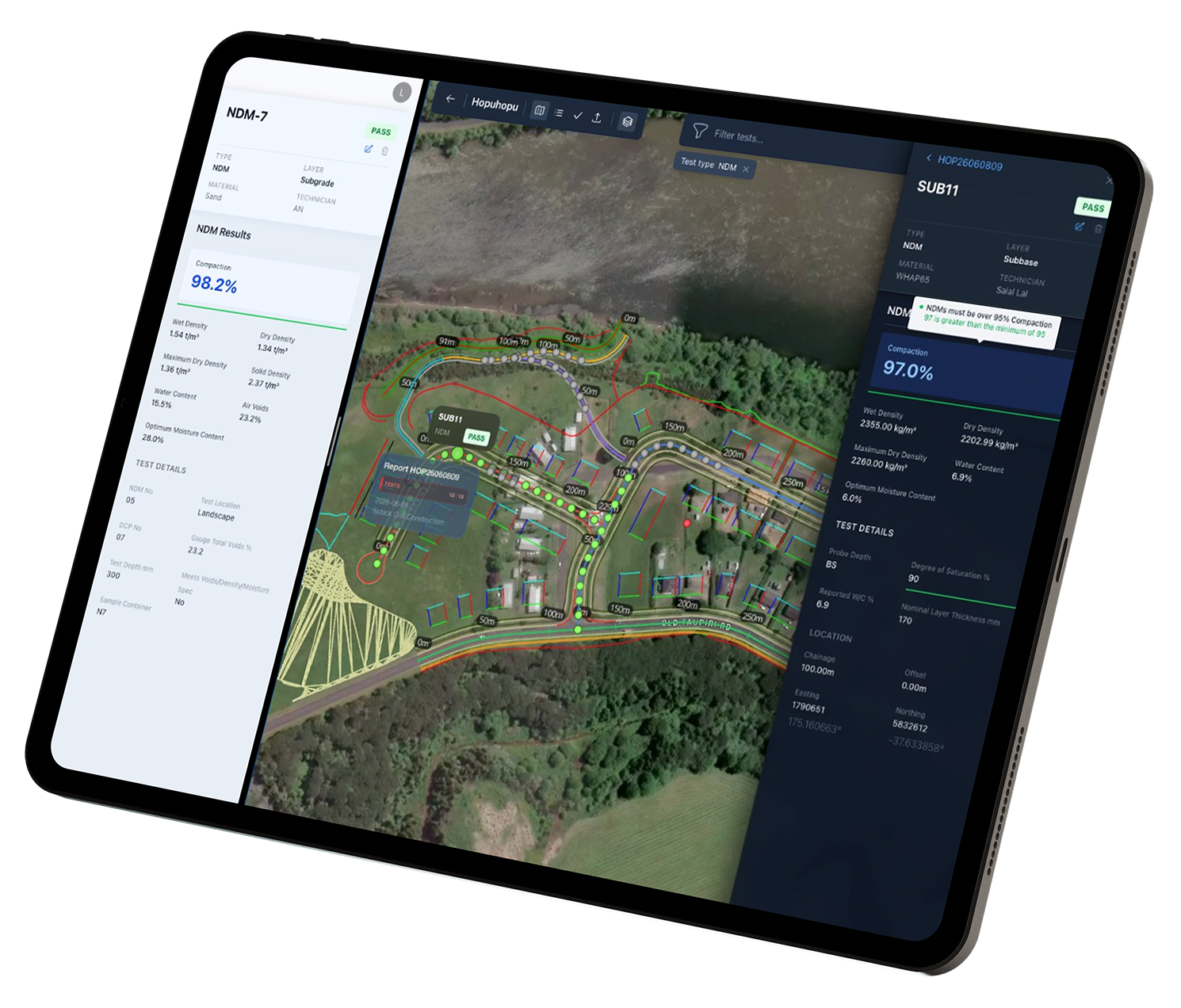
Testbed turns buried test reports into clear, searchable evidence so roading teams can see what passed, what failed, where issues are appearing, and whether remedial work has resolved them.

  • Better visibility across project testing
  • More confidence in compliance review
  • Faster access to evidence hidden in reports
Conceptual evidence view Alignment A03 / Pavement Layer
Review support
Chainage Test Layer Result
1,240m Density Basecourse Pass
1,410m Scala Subgrade Review
1,590m Compaction Fill Fail

The problem

Important test evidence is often there. It is just too hard to see clearly.

Large roading projects can generate thousands of pavement and geotechnical tests across reports, forms, spreadsheets and PDFs. When results are buried in manual review, it becomes harder to spot failures, missed issues and patterns across the work.

01

Manual review hides risk

Engineers can spend time searching through individual reports instead of seeing the bigger picture across layers, sections and alignments.

02

Data capture is slow

Manual forms and re-entry into spreadsheets or systems can delay access to the evidence teams need while the work continues to move forward.

03

Failures are hard to assess

When criteria, locations and results are disconnected, it is difficult to quickly understand what passed, what failed and where attention is needed.

What Testbed does

From scattered reports to structured test evidence.

Testbed helps roading and infrastructure teams bring test evidence into one reviewable view. Reports can be uploaded, key values extracted, criteria applied and results mapped back to the road alignment.

It is built to support engineering review, not replace it. Teams can check extracted information, define the criteria that matter and use the evidence to support clearer compliance conversations.

Upload reports

Bring manual reports and scanned test evidence into the review process.

Extract values

Turn report content into structured evidence that can be checked, searched and reviewed.

Apply criteria

Evaluate tests against project, layer, section or alignment requirements.

How it works

A clearer path from test report to project visibility.

  1. 1

    Upload test reports

    Start with the reports teams already receive from testing activity.

  2. 2

    Extract key values into structured evidence

    Convert buried report content into searchable, reviewable test data.

  3. 3

    Define project-specific criteria

    Set the thresholds that matter for each test, layer, section or project requirement.

  4. 4

    Review pass/fail results

    Quickly see where results meet criteria, fail criteria or need engineering review.

  5. 5

    Map issues to the road alignment

    Understand exactly where quality issues are appearing across the work.

  6. 6

    Track retesting and change over time

    See whether remedial work has resolved the issue and where further attention is needed.

Core capabilities

Built around how engineers review test evidence.

Testbed focuses on the practical steps between receiving test reports and understanding what the evidence says about the project.

Report upload and extraction

Upload manual reports and extract the values needed for checking, searching and review.

Criteria-based evaluation

Define the rules that matter by test type, layer, section, alignment or project requirement.

Pass, fail and review status

Highlight results that meet criteria, miss criteria or need further engineering attention.

Road alignment mapping

Map test evidence back to the alignment so issue locations are easier to understand.

Focused filtering

Filter by the details that matter, including test type, chainage, layer, alignment or extracted fields.

Retesting visibility

Track whether remedial work and retesting have resolved the original issue.

Road alignment visibility

See where issues are forming, not just that they exist.

A failed result is more useful when teams can see where it sits in relation to the road, the layer, the section and the surrounding evidence.

Testbed is designed to help teams move from isolated test records to a clearer project-level view of quality evidence.

Test type: Scala Layer: Subgrade Chainage: 1,200m–1,700m
42 Tests reviewed
35 Passing
5 Review
2 Failing

Example only. Final project evidence remains subject to engineering review and verification.

Who it is for

For teams responsible for proving, reviewing and understanding roading test evidence.

Roading engineers

Review test evidence against the requirements that matter for the project.

Geotechnical engineers

Understand how test data relates to ground conditions, layers and locations.

Quality engineers

Define criteria, monitor failed results and support compliance review.

Engineering consultancies

Give project teams better access to evidence across complex works.

Infrastructure project teams

Surface issues earlier and support clearer conversations between parties.

Asset owners

Gain better visibility into the evidence behind handover, maintenance and future risk.

Product walkthrough

See the product story in context.

The walkthrough introduces the core problem: roading projects generate large volumes of test evidence, and teams need a clearer way to review, assess and map the results.

Designed for careful review

Decision support, not decision replacement.

Testbed is designed to make test evidence easier to access, check and understand. It helps teams surface results and evaluate them against defined criteria, while leaving engineering judgement where it belongs: with qualified people.

Extracted information should be reviewed and verified as part of the normal project evidence process.

FAQ

Questions engineers are likely to ask.

What is Testbed?

Testbed is an engineering evidence and test-result visibility platform for roading and infrastructure projects. It helps teams upload reports, structure test evidence, evaluate results against criteria and map issues to the road alignment.

Who is Testbed for?

It is designed for roading engineers, geotechnical engineers, quality engineers, engineering consultancies, infrastructure project teams and asset owners who need clearer visibility of test evidence.

Does Testbed replace engineering judgement?

No. Testbed supports engineering review by making evidence easier to find, check, compare and understand. It does not replace qualified engineering judgement.

Does Testbed make automatic compliance decisions?

No. Testbed evaluates results against criteria defined by the project team and highlights pass, fail or review status. Final interpretation and action remain with the project team.

What kinds of reports can Testbed support?

Testbed is designed around the kinds of manual reports, scanned documents, forms and PDFs commonly produced during pavement and geotechnical testing workflows.

Can results be mapped to the road alignment?

Yes. A key purpose of Testbed is to help teams see where results and issues are appearing in relation to the road alignment, section, layer and surrounding evidence.

Can teams define their own criteria?

Yes. Engineers can define the criteria that matter for each test, layer, section, alignment or project requirement.

Can Testbed help with retesting and remedial work visibility?

Yes. Testbed is designed to help teams track whether later testing and remedial work have resolved the original issue or whether further attention is needed.

How do I book a demo?

Use the form below and the Testbed team will contact you about a product walkthrough.

Book a demo

See how Testbed can support your testing evidence workflow.

Share a few details and we will contact you about a product walkthrough focused on roading and infrastructure test evidence.

Report upload Criteria review Pass/fail visibility Road alignment mapping

Request a product walkthrough

Submit your details and we’ll contact you about a product walkthrough. Your information will only be used to respond to your enquiry.